VCS Very Critical Service Flange Insulation Gasket Kit
Product Description
Product Detail
VCS Very Critical Service Flange Insulation Gasket Kit — API 15,000 psi Isolation for RTJ, RF & Mismatched Flanges
The Seal Is Pressure-Activated — That Changes Everything
Not a Solid Phenolic Gasket with a Higher Rating
Standard RTJ phenolic insulation kits fail in high-pressure acid gas service for one reason: they rely on bolt stress to compress a solid gasket into the groove. At API 15,000 psi, the bolt load required to maintain that compression becomes impractical, and the phenolic ring itself can crack or extrude. The VCS uses a different mechanism. A PTFE spring-energized face seal is seated in a machined groove in the 316 stainless steel core. Line pressure enters the seal cavity and loads the PTFE element from behind. The higher the pressure, the tighter the seal — it does not need high bolt stress to start sealing. That is why the VCS covers API 15,000 psi / ANSI 2500# and still seals at low bolt load.
VCS vs Phenolic RTJ Insulation Kit — The Failure Mode Difference
| Dimension | VCS (this page) | Phenolic RTJ kit (Type D) |
|---|---|---|
| Seal activation | Pressure-activated — line pressure loads the seal | Bolt-stress-activated — requires high torque to compress |
| Pressure ceiling | API 15,000 psi / ANSI 2500# | ANSI 300 typical (solid phenolic limit) |
| Acid gas / CO₂ / H₂S service | Designed for fluid-trap corrosion elimination | Not the primary service; phenolic can degrade |
| Mismatched RTJ ↔ RF flanges | Seals in RF, FF and RTJ; can mate mismatched | RTJ groove only; will not seal on RF |
| Seal replacement | PTFE seal elements replaceable in reusable retainer | Gasket is a single-use phenolic ring |
| Core material | 316SS (Duplex/Inconel optional) | None — solid laminate only |
If the service is standard pressure and the flange is a clean RTJ groove, a phenolic kit such as Type D RTJ insulation kit is the lower-cost choice. The VCS is specified when the cost of gasket failure cannot be tolerated — high-pressure acid gas, mismatched flanges, vibration, or RTJ phenolic kits that have already failed in service.
API 15,000 psi Is Not the Only Advantage — Mismatched Flange Adapter
The VCS seals in RF, FF and RTJ flanges because the PTFE face seal sits in the core, not in a flange groove. This allows the VCS to act as an RTJ-to-RF adapter insulation gasket: when a ring-joint flange must be isolated against a raised-face flange, the VCS provides both the seal and the electrical barrier without a separate spacer. This is a common field problem in wellhead tie-ins and flowline retrofits, where flange facings do not match. For standard full-face isolation on well-machined flanges, see Type E full-face insulation kits.
Technical Data — KVCS 100
| Metal core | Annealed 316 stainless steel (standard); Duplex, Inconel 625/825, SMO 254, AL6XN optional |
|---|---|
| Insulating carrier | G-10 glass-reinforced epoxy laminate (standard); G-11 optional |
| G-10 compressive strength | 65,000 psi |
| G-10 dielectric strength | 750–800 VPM |
| G-10 continuous temperature | 150°C (302°F) |
| G-10 water absorption | 0.05% |
| G-10 flexural / tensile strength | 65,000 psi / 50,000 psi |
| G-11 alternative | 50,000 psi compressive; 500 VPM; 177°C continuous |
| Seal material | PTFE spring-energized face seal (standard); elastomeric O-ring optional |
| Pressure class | API 10,000# / 15,000#; ANSI 2500# |
| Flange compatibility | RF, FF, RTJ; mismatched RTJ-to-RF |
| Seal replaceability | PTFE seal elements replaceable in reusable retainer |
For standard pressure classes where a solid phenolic kit is sufficient, see Type F raised-face kits or neoprene faced phenolic kits. For G10 sleeves and washers as separate components, see G10 insulation sleeves.
Where the VCS Is Specified — Acid Gas, Cathodic Protection, Vibration
The VCS is the default isolation kit for acid gas service VCS gasket applications where CO₂, H₂S and produced water create fluid-trap corrosion in RTJ flanges. It is also specified for cathodic protection isolation on high-pressure pipelines, galvanic corrosion prevention between dissimilar metal flanges, wellhead-to-flowline isolation, and flanges subject to vibration or cavitation (compressor stations). The pressure-activated seal maintains integrity under temperature and pressure cycling — conditions where a solid phenolic RTJ ring would relax and leak. For cathodic protection isolation on standard pressure classes, the flange insulation gasket kit range lists the full selection.
Kit Contents, Reusability and Factory Traceability
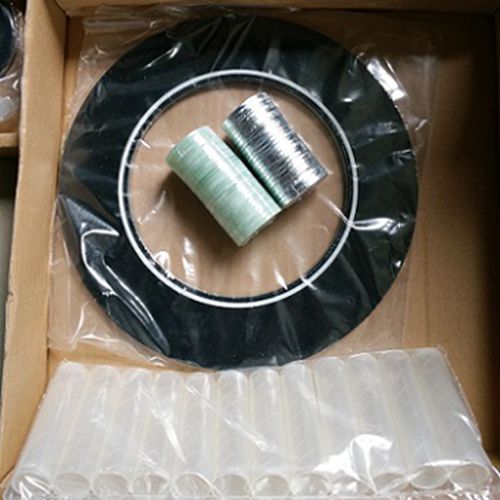
Each KVCS 100 kit includes the VCS central gasket, G-10 insulating sleeves (1/32″ wall), G-10 insulating washers (1/8″ thick) and zinc-plated steel back-up washers. The gasket retainer is reusable; the PTFE seal elements can be replaced without replacing the entire gasket. Kaxite operates an ISO 9001 quality system; kits are supplied with material certificates and dimensional inspection records. Third-party inspection (SGS, BV, Intertek) can be coordinated.
MOQ, Lead Time and Ordering Specification
Standard MOQ is 10 sets; standard lead time is 7–15 days for standard VCS kits. Custom core materials, G-11 carrier and non-standard flange dimensions are quoted separately. To quote a VCS kit correctly, the following must be specified at inquiry: flange standard, nominal pipe size, pressure rating and bore size, operating pressure/temperature/media, seal material, and sleeve/washer material. This is not a catalog-part number order — the VCS is configured to the flange and service.
Buyer FAQ
- What is the difference between VCS and a phenolic RTJ insulation kit?
- A phenolic RTJ kit is a solid laminate ring that seals by bolt stress compression in the groove; its practical pressure ceiling is ANSI 300. The VCS uses a 316SS core with a PTFE spring-energized seal that is loaded by line pressure, covering API 15,000 psi / ANSI 2500#. The VCS also seals mismatched RTJ-to-RF flanges and is designed for acid gas service where phenolic kits fail.
- Can the VCS seal a mismatched RTJ to raised-face flange?
- Yes. Because the PTFE face seal sits in the core rather than relying on a flange groove, the VCS seals in RF, FF and RTJ flanges and can act as an RTJ-to-RF adapter insulation gasket. State both flange facings at inquiry so the seal configuration is confirmed.
- Is the seal replaceable, or is the whole gasket single-use?
- The PTFE spring-energized seal elements are replaceable in the reusable retainer. The 316SS core and G-10 laminate are not consumed in service. This reduces lifecycle cost on critical flanges where the gasket is inspected or refurbished.
- What acid gas conditions is the VCS designed for?
- The VCS is specified for RTJ flanges in CO₂, H₂S and produced water service where fluid-trap corrosion and flow-induced erosion occur. The pressure-activated seal maintains isolation under these conditions; a solid phenolic RTJ ring is not the correct material for this duty.
- What is the maximum temperature for the G-10 carrier?
- G-10 continuous service is 150°C (302°F). G-11 is available for 177°C (350°F) continuous. The PTFE seal and elastomeric O-ring options have their own temperature limits — confirm the complete seal/carrier combination for the service temperature at inquiry.
- What is the MOQ and lead time for a VCS kit?
- MOQ is 10 sets for standard configurations; standard lead time is 7–15 days. Custom core materials and non-standard sizes are quoted with confirmed timing. The VCS is configured to the flange and service, so the ordering specification (flange standard, size, pressure class, media, temperature) must be provided for quotation.
Send your flange standard, size, pressure class, bore, media and temperature. Engineering team confirms the VCS seal/carrier configuration and returns quotation with lead time.
Request VCS Kit Quotation